
CVE-2024-4577 Attack Blocked: How HiveProtect Protects Your WordPress Even Without Patched Servers
A major exploitation attempt stopped on your site
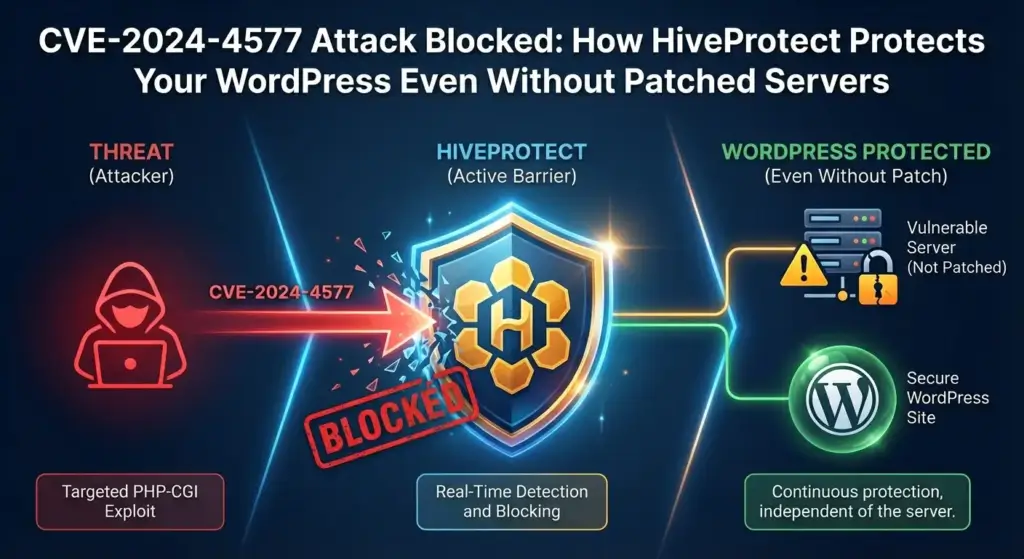
A critical attack has been detected and blocked on your WordPress site from Lauterbourg (France). The attacker used a specialized string /hello.world?%ADd+allow_url_include%3d1+%ADd+auto_prepend_file%3dphp://input to try to exploit the CVE-2024-4577 vulnerability, one of the most dangerous PHP flaws ever discovered. This incident is a perfect example of why having a multi-layered WordPress security solution is essential in 2025.
CVE-2024-4577: The flaw that ravaged PHP servers in 2024
What exactly is CVE-2024-4577?
The CVE-2024-4577 vulnerability is a critical flaw in the PHP CGI (Common Gateway Interface) engine that affects Windows installations of PHP 8.1, 8.2, and 8.3. Discovered in June 2024 by security researchers Orange Tsai and the DEVCORE team, this vulnerability allows an unauthenticated attacker to execute arbitrary code on the server via malicious argument injection.
With a CVSS score of 9.8 (critical), this flaw is based on a sophisticated mechanism: the « Best-Fit » Windows coding conversion system allows attackers to bypass the protections put in place against CVE-2012-1823, a similar vulnerability dating back to 2012. By using special characters like the Unicode %AD conditional hyphen, attackers bypass standard security filters.
How the attack works
The attack intercepted on your site followed the classic pattern: the attacker sent a specially formatted HTTP request containing the parameters -d allow_url_include=1 -d auto_prepend_file=php://input. These PHP directives would have made it possible to:
- Enable the allow_url_include option, allowing PHP to include external files via HTTP or FTP
- Configure auto_prepend_file=php://input to preprocess any PHP file with content coming directly from the HTTP request input stream
If the server had been vulnerable, the attacker could have injected malicious PHP code directly into the request body, which would be executed before any other resources were processed. The result: full access to the server, permission to install backdoors, exfiltrate data, or deploy ransomware.
RFI and PHP Stream Wrappers: Modern Injection Techniques
Understand the detected RFI attack
Beyond CVE-2024-4577, the attempted attack on your site also exploited a technique called RFI (Remote File Inclusion). The pattern detected by HiveProtect confirmed this approach: /(php|data|expect|phar):///i.
PHP wrappers like php://, data://, expect://, and phar:// are legitimate PHP language mechanisms for accessing different types of data streams. However, attackers regularly hijack them to:
- Execute arbitrary PHP code via php://input
- Encode malicious code in base64 and then inject it via data://
- Exploit WordPress plugin-specific vulnerabilities via lesser-known wrappers
In your case, the attacker used php://input combined with PHP guidelines, a two-pronged approach to maximize the chances of success.
The importance of passive detection: when your server is not patched
The reality for WordPress admins
Many WordPress site owners find themselves in a tricky situation: although PHP patches have been around since June 2024 (PHP 8.1.29+, 8.2.20+, 8.3.7+), applying these updates remains problematic for some admins due to:
- Compatibility with existing plugins and themes
- Limitations imposed by their host (some still on older versions)
- Complex server configuration requiring regular maintenance
- Limited resources to test updates before deployment
This is precisely where HiveProtect comes in. Even if your server environment hasn’t applied PHP security patches, your security plugin acts as an extra layer of protection, detecting and blocking known exploitation attempts.
How HiveProtect stopped this attack
HiveProtect intercepted the attempt by applying its detection pattern for PHP wrappers : /(php|data|expect|phar):///i. This rule immediately identifies RFI exploitation attempts before they can affect your WordPress installation.
The « Critical: 100 » rating in the logs indicates that the plugin recognized the pattern as highly dangerous and blocked it without even allowing the request to reach your WordPress code. It is an effective defence in depth , particularly against:
- Known and documented exploits
- Minor variants of existing faults
- Automated attacks targeting popular vulnerabilities
Zero-Day Threats: The Weak Link in Security
What is a zero-day vulnerability and why does it terrify administrators?
A zero-day vulnerability is a security flaw discovered by attackers before security researchers or developers are aware of it. Unlike documented vulnerabilities for which patches exist, zero-days provide cybercriminals with a window of opportunity: days, weeks, or months before a patch is released.
In 2025, zero-days are becoming increasingly profitable for advanced cybercriminal groups. Recently, HiveProtect and other WordPress security solutions have identified several critical zero-days:
- CVE-2025-7384 : A Remote Code Execution (RCE) flaw in a popular WordPress plugin, allowing code execution without authentication
- WP GDPR Compliance zero-day : discovered in 2025, actively exploited to install backdoors before the plugin is removed
- Multiple vulnerabilities in file upload plugins, bypassing standard WAF protections
How zero-days bypass traditional protections
Zero-days are particularly insidious because they do not use known vectors. They operate:
- Flaws in the plugins’ business logic (not just basic coding errors)
- Combined vulnerability chains that no single tool has detected individually
- Sophisticated code foruscation techniques
- Payloads encoded to evade standard filters
HiveProtect: Behavioral and heuristic detection
Beyond simple patterns
While HiveProtect effectively blocks known attacks like CVE-2024-4577 via regex patterns, its true strength lies in its ability to detect suspicious behavior even when the exact signature of the vulnerability is unknown.
When you confront zero-days :
- Behavioral detection : HiveProtect monitors for anomalous request patterns, even if they don’t match a known signature
- Heuristic analysis : the plugin evaluates the overall risk of a request, not just the presence of certain characters
- Multi-layer protection : Even if a first layer is bypassed, the following layers are involved
In your situation, the plugin has classified the attack as « Critical: 100 » thanks to several factors: the unusual User-Agent header (libredtail-http), the structure of the request, the network origin (Contabo, external DNS server), and of course the PHP injection pattern.
Recommendations to strengthen your WordPress security
Progressive patching
Even though HiveProtect protects you today, plan to apply PHP security updates in a test environment. The fixed versions (PHP 8.1.29+, 8.2.20+, 8.3.7+) eliminate CVE-2024-4577 at the source.
Continuous log monitoring
HiveProtect blocking logs like this are valuable. They reveal the attack vectors currently used against WordPress sites. Analyze this data regularly to identify trends.
Server configuration
Even in a shared environment, you can ask your hosting provider:
- Disable allow_url_include at the global PHP level
- Restrict direct access to PHP CGI binaries
- Implement a WAF (Web Application Firewall) at the server level
Updating plugins and themes
HiveProtect protects you from external exploits, but vulnerabilities in your plugins and themes are still dangerous. Keep all your WordPress components up to date.
Conclusion: In-depth security saves sites
The crash stuck on your WordPress demonstrates why the defense-in-depth theory is not optional. Even if your server is not yet patched against CVE-2024-4577, HiveProtect acted as a shield, stopping an attack that could have compromised your site completely.
In 2025, with the increase in zero-day exploits and the increasing complexity of attack vectors, a combined approach that includes signature detection, behavioral analysis , and continuous monitoring is essential. Your WordPress site is never too well protected against today’s threats.
